
 Economic Enquirer
The Best Marketing Books in 2026 including March’s Top Pick
Marketing advice is rarely in short supply. What is scarce is judgement. For business owners, the challenge is no longer access to ideas, tools or frameworks. It is deciding which ones deserve attention, investment and organisational belief. The wrong marketing philosophy does not simply waste budget. It shapes hiring decisions, product direction and how much of the business ultimately depends on the founder’s presence.
That is why certain marketing books continue to sell long after trends shift and platforms change. They are not consumed for tactics, but for orientation. They help owners decide what kind of business they are building, and what role marketing should play inside it.
The books that follow have remained on hit lists globally because they answer that deeper question. Each reflects a distinct view of growth, customer behaviour and control. Read together, they form a map of how modern businesses are learning to scale with greater discipline and less noise.
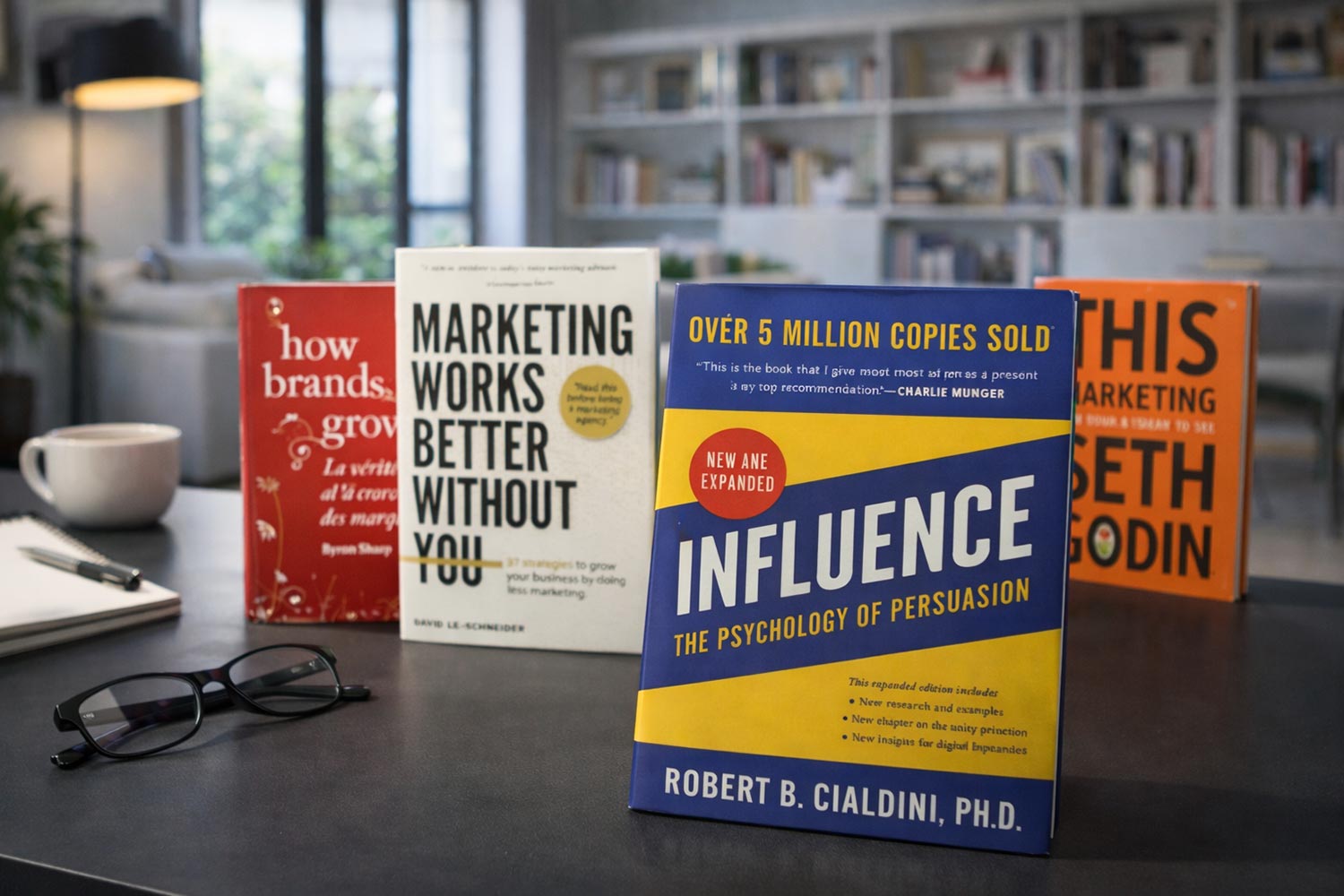
1. Influence by Robert Cialdini Top-Pick
No marketing book has travelled further across disciplines than Influence. Originally grounded in academic research, it has become required reading not only for marketers, but for executives, negotiators and policymakers.
Its longevity stems from its refusal to chase novelty. Cialdini does not teach persuasion as a set of tricks, but as a set of human constants. Reciprocity, commitment, social proof and authority do not expire because technology advances. They merely find new expression.
For business owners, Influence functions as a diagnostic tool. It clarifies why pricing fails, why sales conversations stall and why otherwise rational customers hesitate. More importantly, it sharpens executive judgement. Once these principles are understood, poor decisions become harder to justify.
This is why the book continues to outperform newer titles commercially. It addresses a permanent layer of business reality.
2. How Brands Grow by Byron Sharp
If Influence explains how people decide, How Brands Grow explains how markets actually expand.
Sharp’s work unsettled an industry built on intuition and storytelling. Using large-scale data, he demonstrated that many widely accepted marketing beliefs do not hold up under scrutiny. Loyalty is weaker than assumed. Differentiation is often overstated. Growth is more strongly correlated with reach and ease of purchase than emotional attachment.
For founders, the book’s appeal is practical rather than academic. It simplifies strategic focus. It challenges owners to ask whether complexity is genuinely required, or simply inherited.
The book’s sustained success reflects its role as a corrective. It strips marketing back to first principles and forces decision-makers to confront uncomfortable evidence.
3. Marketing Works Better Without You by David Lee-Schneider
Where many marketing books focus on growth, this one focuses on dependency.
Marketing Works Better Without You addresses a reality many founders privately recognise. As the business grows, marketing often becomes more demanding, not less. The founder remains the arbiter of messaging, channels and judgement, long after the company has outgrown that model.
Lee-Schneider reframes marketing as infrastructure rather than expression. Systems that operate quietly. Assets that compound. Decisions that reduce reliance on individual involvement.
The book’s commercial traction reflects a shift in founder priorities. Growth is no longer the sole objective. Control, leverage and sustainability matter just as much. Marketing, in this view, is successful when it removes itself as a daily concern.
4. This Is Marketing by Seth Godin
Godin’s work endures because it speaks to restraint.
This Is Marketing rejects the idea that success comes from scale alone. Instead, it argues for relevance, empathy and commitment to a defined audience. It asks business owners to choose who they are for, and accept who they are not.
For founders navigating growth, the book offers a counterbalance to expansion at any cost. It encourages discipline in positioning and patience in execution. Marketing, in Godin’s framing, becomes a long-term promise rather than a series of campaigns.
Its continued popularity reflects a desire among leaders to build businesses with coherence, not just reach.
5. Positioning by Al Ries and Jack Trout
Few books have influenced strategic thinking as quietly as Positioning.
Its central insight is deceptively simple. Markets are not defined by products, but by perceptions. Once a category is mentally owned, competitors must work exponentially harder to dislodge it.
For business owners, this book often resurfaces during moments of confusion. When messaging becomes diffuse. When differentiation feels forced. When growth slows despite operational competence.
Its continued relevance lies in its precision. It does not offer inspiration. It offers clarity.
6. Purple Cow by Seth Godin
If Positioning explains where competition occurs, Purple Cow explains why sameness fails.
Godin’s argument is direct. In crowded markets, being competent is invisible. Only products and services that are inherently noteworthy earn attention.
For founders, the book functions as a challenge rather than a guide. It forces uncomfortable questions about whether a business is genuinely distinct, or merely well executed.
Its commercial success reflects a recurring founder realisation. Efficiency alone rarely creates growth. Distinction does.
7. Building a StoryBrand by Donald Miller
As businesses grow, complexity tends to surface first in language.
What begins as a clear value proposition often fragments into layered messaging, internal shorthand and competing priorities. Building a StoryBrand found its audience by addressing that specific breakdown.
Miller’s contribution was not inventing storytelling in business, but operationalising clarity. By positioning the customer as the protagonist and the business as the guide, the framework gave founders a repeatable way to simplify communication across websites, sales material and internal alignment.
Its commercial success reflects a practical need. In competitive markets, clarity is not a branding exercise. It is a performance advantage.
8. DotCom Secrets by Russell Brunson
Where many marketing books speak in abstraction, DotCom Secrets is unapologetically structural.
Brunson focuses on the mechanics of turning interest into revenue. Funnels, offers and buyer journeys are treated not as creative artefacts, but as systems that can be built, tested and refined.
For founders operating digital or productised businesses, the appeal lies in predictability. The book provides a way to reduce reliance on bespoke selling and move toward repeatable conversion pathways.
Its sustained popularity reflects the enduring appeal of systems that scale without constant reinvention.
9. Epic Content Marketing by Joe Pulizzi
Pulizzi’s work arrived as businesses began to recognise that attention could not be rented indefinitely.
Epic Content Marketing reframes content as an owned asset rather than a promotional tactic. The emphasis is on consistency, relevance and long-term audience trust, rather than immediate reach.
For founders, the book offers a disciplined alternative to reactive publishing. Content, in this model, becomes part of the company’s operating system, generating demand gradually and predictably.
Its influence is most visible in businesses that prioritise authority and inbound growth over short-term acquisition.
10. Contagious by Jonah Berger
Contagious examines a question many businesses ask too late. Why do some ideas spread while others disappear quietly.
Berger approaches the problem through behavioural science rather than creative instinct. Social currency, triggers and emotion are treated as observable forces, not artistic flair.
For founders, the value lies in understanding distribution as a design problem. Products, messages and experiences can be shaped to travel further, without proportional increases in spend.
The book’s appeal extends beyond marketing because it explains how influence propagates in any system.
11. Alchemy by Rory Sutherland
Sutherland’s central argument is that business often overvalues logic and undervalues perception.
Alchemy challenges the assumption that optimisation is always the answer. Instead, it highlights how context, framing and human psychology can deliver disproportionate outcomes.
For founders, the book serves as a counterweight to efficiency-driven thinking. It legitimises intuition, experimentation and non-linear problem solving, particularly in saturated markets where marginal gains are insufficient.
Its commercial success reflects a growing appetite for insight that escapes spreadsheets.
12. Quantum Marketing by Raja Rajamannar
Quantum Marketing addresses a structural shift rather than a tactical one.
As automation, data and AI reshape how customers interact with brands, Rajamannar argues that traditional models of marketing decision-making are no longer adequate. The book explores how leaders can adapt without relying on legacy assumptions.
For founders operating in complex or fast-moving environments, it offers a strategic lens rather than prescriptions. The emphasis is on adaptability, systems thinking and organisational readiness.
Its relevance lies in preparing decision-makers for uncertainty, not attempting to eliminate it.
Closing Perspective
Taken together, these twelve books tell a coherent story about how marketing is evolving inside founder-led businesses.
The emphasis has shifted away from constant activity and toward structure. Away from visibility and toward leverage. Away from intuition alone and toward informed judgement.
What distinguishes the most enduring titles is not their ability to generate growth quickly, but their ability to reduce dependence over time. Marketing, at its best, becomes quieter as the business becomes stronger.
That is ultimately why these books continue to sell. They do not promise momentum. They offer orientation.
And for business owners navigating scale, that may be the most valuable asset of all.